
For most commercial real estate sponsors, the hardest capital to find isn't the money to buy land or break ground. It's the commercial tenant improvement loan that gets a nearly finished project across the finish line.
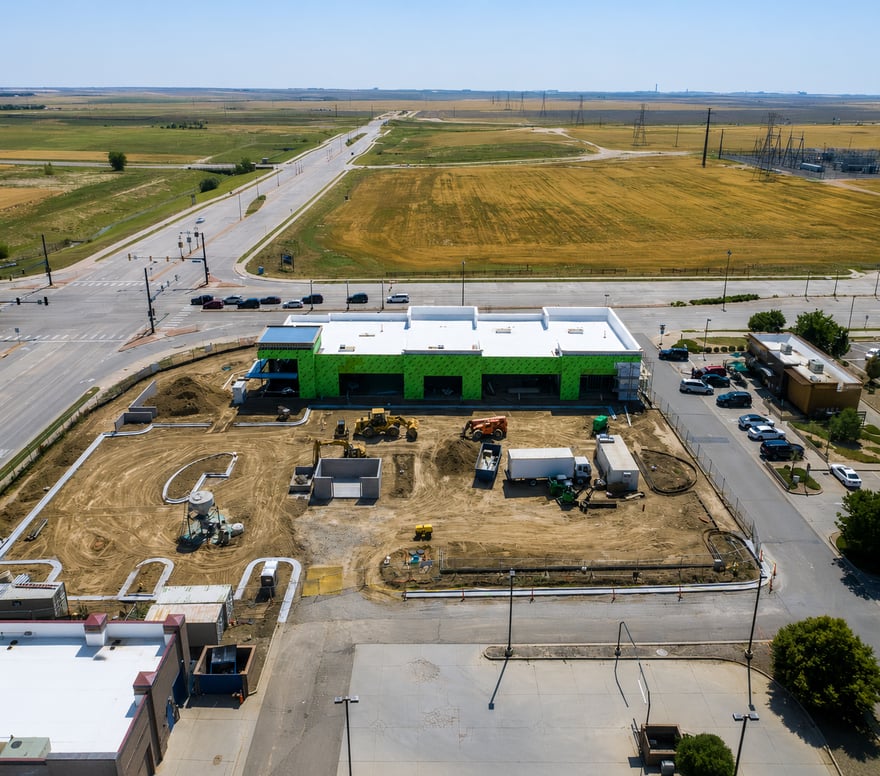
That was exactly the position one experienced development group found themselves in after spending three years transforming a parcel in Commerce City, Colorado, into an 8,200-square-foot multi-tenant commercial property. The sponsors had already invested more than $4.2 million and brought the project close to completion. But with tenants committed and construction nearing the certificate-of-occupancy stage, conventional lenders would not provide the remaining tenant improvement capital needed to actually open the doors.
Leases were signed with a cannabis tenant, a nail salon, and a large owner-occupied hospitality concept designed to host smaller food operators. All that stood between the project and its grand opening was TI capital, and that's exactly where conventional financing broke down.
Learn how Socotra Capital stepped in where traditional banks backed away, structuring a $1.565 million hard money commercial loan against an $8.275 million after-repair value.
Why Conventional Lenders Said No
On paper, the sponsors were about as strong as a lending team could ask for: excellent credit, solid financials, and seasoned development experience. Most importantly, more than $4.2 million of their own money was already invested before they ever approached a lender.
This is exactly the kind of borrower commitment underwriters look for first. Yet traditional banks passed on providing a commercial tenant improvement loan.
Tenant-in-Common Ownership
The borrowers held roughly 70 percent of the property through a tenant-in-common (TIC) ownership structure, with a separate group controlling the remaining interest. Tenant-in-common financing is notoriously difficult for conventional lenders to underwrite because TIC arrangements complicate enforcement and foreclosure rights if something goes wrong. Many banks simply won't touch it, regardless of borrower strength.
Cannabis Tenant Exposure
One committed tenant was a cannabis operator. The tenant funded its own buildout entirely, and Socotra financed none of that suite's improvements, but even adjacent cannabis exposure is enough to push most institutional lenders out of a deal.
Complex, Multi-Entity Ownership
A holding company, several subsidiary entities, and a web of partnership interests among family members and outside investors meant that understanding guarantor exposure and collateral rights required significant diligence, more than most conventional underwriting teams are built to handle.
Startup Hospitality Concept
The primary hospitality tenant hadn't opened yet. Despite signed leases and substantial construction progress, many banks categorized the project as a startup operating business and wanted a longer track record before releasing TI dollars.
The sponsors had looked at other options, including a lender that offered equipment financing tied to business performance. But that lender wanted more operating history and financial documentation than a concept that hadn't opened yet could provide. Between the TIC structure, cannabis tenant exposure, startup risk, and occupancy levels below what standard tenant-improvement lenders typically require, this deal didn't fit the mold for conventional financing.
If your project has hit the same wall—strong equity, real progress, and a "no" from every bank you've talked to—schedule a commercial loan consultation to see how a non-conforming structure might still get you to closing.
How Socotra Structured a Commercial Tenant Improvement Loan Solution
Socotra evaluated the complete transaction, including the ownership structure, collateral, construction status, tenant commitments, sponsor experience, and the substantial equity already invested. That analysis showed that the sponsors had both the financial capacity and the economic incentive to complete the project
The Loan Structure
The result was $1.565 million in total loans, including $1.32 million in dedicated tenant improvement funding—precisely the capital stack the borrowers needed to move tenants in and open for business. Against an after-repair value (ARV) of roughly $8.275 million, the loan gave sponsors room to complete the project without diluting the equity they'd already committed.
Just as important as the loan amount was the loan structure. Socotra structured the loan with amortizing payments based on a 25-year schedule and included a 12-month interest reserve to support the project through completion.
Rather than forcing a hard refinance deadline on a business that hadn't opened yet, the structure gave the sponsors flexibility to stabilize on their own timeline. This is a sign of a well-structured commercial bridge loan built for a real-world project instead of a textbook one.
Hard Money Commercial Loan Execution
Structuring the loan was only half the equation. The borrowers weren't looking for long-term capital; they needed short-term financing that preserved liquidity for other projects while getting this one open.
Once permits were issued, construction moved fast, and it needed a lending partner who could keep pace. That's where commercial draw funding made the difference.
As the general contractor pushed through the final stages of buildout, Socotra processed draws quickly and reliably, keeping cash flowing to the job site without the delays that so often stall momentum on complex projects. Both the borrowers and their contractor pointed to this responsiveness as one of the most valuable parts of working with Socotra.
The deal was brought to Socotra through a broker familiar with the company's experience in cannabis-adjacent and construction financing, which is exactly the kind of tenant improvement challenge conventional lenders routinely avoid.
Completion to Cash-Out Refinancing
With TI funding in place and draws keeping construction on schedule, the project progressed without significant issues through the remainder of the build. The borrowers ultimately secured a cash-out refinance through another hard money lender, leveraging the property's improved value and anticipated operating performance to pay off the Socotra loan in full and fund the FF&E (furniture and equipment) purchases needed to prepare for launch.
Your Lending Partner for Complex Commercial Projects
Tenant-in-common ownership, cannabis tenancy, multi-entity structures, and startup operating risk are exactly the kinds of characteristics that make banks say no. They're also exactly the kinds of deals Socotra Capital is built to underwrite by focusing on sponsor strength, existing equity, and project fundamentals instead of forcing every deal through a conventional lending checklist.
If you're a developer or broker working through a commercial project that doesn't fit a standard bank's lending box, explore Socotra's commercial bridge loan and construction loan options, browse more case studies of complex deals we've closed, or read our hard money loan structuring guide to understand how these deals come together. Brokers can also learn more about partnering with us through the Socotra Broker Referral Partner Program.